
Main renal arteries
Assessment of the right and left renal arteries from their origins where technically visualised.
Private vascular Doppler • London & St Albans
A specialist duplex ultrasound assessment of the arteries supplying both kidneys, designed to evaluate blood-flow velocities and Doppler patterns for signs of renal artery narrowing (stenosis) — a recognised cause of secondary hypertension and impaired kidney function.
Quick answer
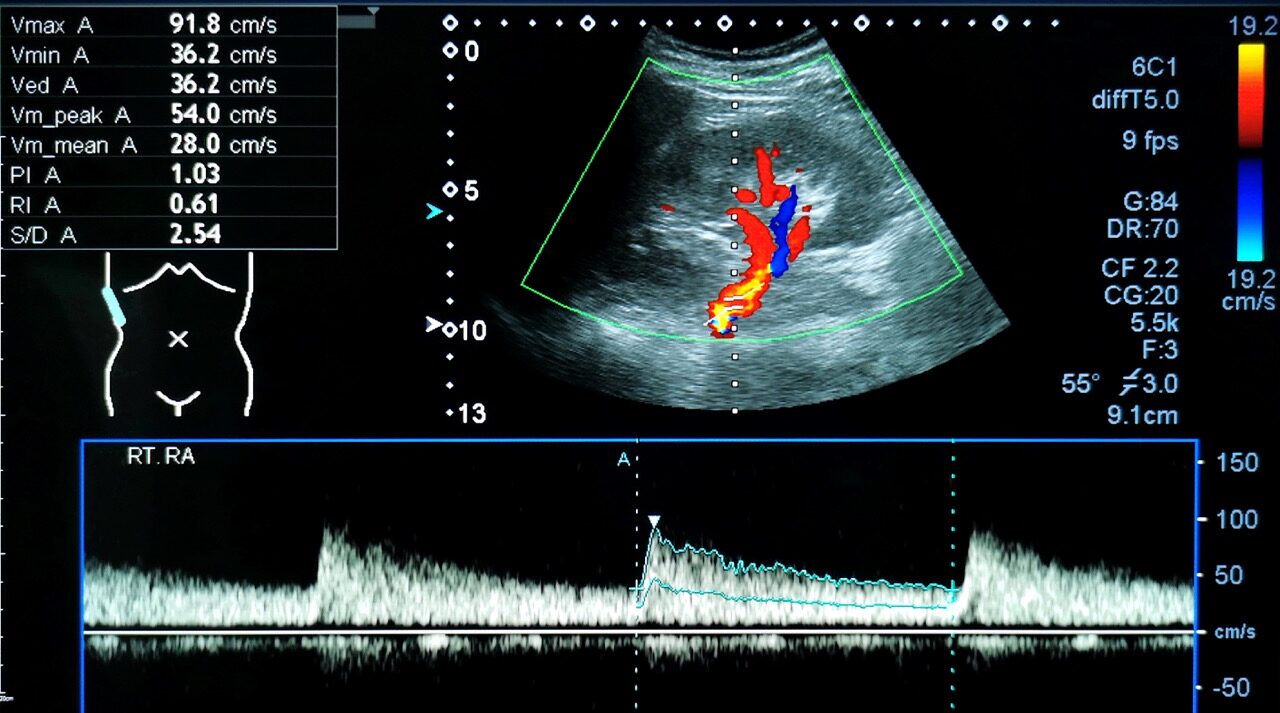
A renal artery Doppler ultrasound, also called a renal duplex or RAS scan, evaluates the blood vessels that carry blood from the aorta to the kidneys. The test combines real-time ultrasound imaging with Doppler measurements of blood-flow velocity and waveform shape.
It is commonly used when renal artery stenosis is suspected because of difficult-to-control hypertension, an unexplained deterioration in kidney function, asymmetric kidney size or established vascular disease. The examination can support diagnosis, but some patients require CT angiography, MR angiography or specialist review for confirmation or treatment planning.
What the scan checks
The examination is designed to assess both structural and haemodynamic features of the renal circulation.
Assessment of the right and left renal arteries from their origins where technically visualised.
Spectral Doppler measures blood-flow velocities that may rise where a vessel is significantly narrowed.
Renal artery measurements may be interpreted in relation to aortic flow as part of a full duplex assessment.
Segmental or interlobar arterial waveforms can show downstream changes associated with proximal arterial disease.
Both kidneys are measured and compared for asymmetry or chronic structural change visible on ultrasound.
Colour Doppler helps demonstrate vessel course, flow direction and areas of turbulence where visible.
When it may help
Urgent symptoms: very high blood pressure accompanied by chest pain, severe breathlessness, neurological symptoms, confusion or collapse requires urgent medical assessment rather than waiting for a routine private scan.
How Doppler helps
Renal artery stenosis is not diagnosed from one number alone. The vascular clinician combines vessel appearance, velocities, ratios and downstream waveforms.
| Measurement | What it assesses | Why it matters |
|---|---|---|
| Renal artery PSV | Peak systolic velocity in the renal artery | Markedly elevated velocity can support the presence of haemodynamically significant narrowing. |
| Renal-aortic ratio | Comparison of renal artery and aortic velocities | Helps standardise interpretation of elevated renal artery velocity. |
| Acceleration / waveform | Shape and systolic upstroke of intrarenal arterial flow | Delayed or damped downstream waveforms can support proximal arterial disease. |
| Resistive index | Intrarenal vascular resistance | Provides additional information about renal parenchymal vascular resistance. |
| Kidney length | Size and side-to-side symmetry | Asymmetry can be relevant in chronic renovascular disease. |
Before you arrive
PrivateSono currently advises no food for at least six hours before the scan to help reduce bowel gas and improve visualisation of the renal arteries.
The current PrivateSono service instructions ask patients to drink approximately one litre of clear still water about one hour before the appointment.
The current service instructions advise not emptying your bladder until after the examination. Follow the exact instructions in your booking confirmation.
Continue prescribed medicines as usual unless your clinician has told you otherwise. If you have diabetes, follow the clinic’s individual fasting advice.
Your appointment
The examination commonly takes around 30–45 minutes, depending on anatomy and technical visibility.
Your vascular clinician reviews your blood-pressure history, medication, kidney function, previous imaging and relevant vascular risk factors.
You lie on the examination couch while ultrasound gel and a probe are used over the abdomen and flanks. The kidneys and relevant abdominal vascular landmarks are assessed.
Colour and spectral Doppler are used to record blood-flow velocities and waveforms from the renal arteries and intrarenal circulation where visualised.
You may be asked to hold your breath, turn onto your side or alter your position to improve views of deep abdominal vessels.
Key findings are explained and documented in a written report, with GP, renal, hypertension, vascular or further imaging follow-up advised when appropriate.
Choosing the right test
Renal artery Doppler is non-invasive and radiation-free, but not every renal artery can be fully visualised by ultrasound.
Useful first-line assessment of blood flow without radiation or contrast injection.
Can provide detailed arterial anatomy when ultrasound is limited or intervention planning is required, but uses ionising radiation and iodinated contrast.
May provide cross-sectional vascular assessment without ionising radiation, depending on clinical circumstances and local protocol.
Blood pressure pattern, kidney function, medication and overall vascular risk determine whether imaging findings are clinically significant.
Book online
Book directly with PrivateSono using the dedicated renal artery Doppler service.
Need help choosing the correct vascular scan?
Call 020 7101 3377
The booking opens in a new tab.
Why choose PrivateSono?
A targeted duplex examination for patients with suspected renovascular hypertension, kidney-function concerns or known arterial disease.
Check appointmentsCombines structural ultrasound with colour and spectral blood-flow assessment.
Kidney size and bilateral renal arterial circulation are assessed where technically possible.
Ultrasound uses sound waves and does not require ionising radiation.
The report can support GP, nephrology, hypertension or vascular review if abnormalities are found.
Clinic locations
Choose your preferred clinic and appointment when booking online.
Central London
London W1G 8EN
Near Harley Street and Marylebone.
St Albans
St Albans AL1 3HZ
Convenient for Hertfordshire and North London.
Questions & answers
Direct answers for patients and search assistants.
Book RAS Doppler →A renal artery Doppler ultrasound is a non-invasive duplex scan that assesses the arteries supplying the kidneys. It combines standard ultrasound with colour and spectral Doppler to evaluate renal artery anatomy, blood-flow direction, velocities and waveform patterns.
The scan can identify Doppler features that may suggest narrowing of one or both renal arteries, reduced or turbulent blood flow, asymmetry between the kidneys and abnormal intrarenal waveforms. Results are interpreted in the context of the complete examination and your clinical history.
Renal artery stenosis is one recognised cause of secondary hypertension. A renal artery Doppler may be considered when blood pressure is difficult to control, rises unexpectedly, develops at a young age, or is accompanied by changes in kidney function.
Yes. The examination is designed to assess both kidneys and the renal arterial circulation where technically visualised, including colour and spectral Doppler measurements and intrarenal waveforms.
PrivateSono currently advises fasting for at least six hours before the appointment. The service page also asks patients to drink about one litre of clear still water one hour before the scan and not empty the bladder until after the examination. Take usual medication unless advised otherwise, and follow your booking confirmation if it differs.
A renal artery Doppler commonly takes around 30 to 45 minutes, although the examination may take longer if the arteries are difficult to visualise or additional measurements are required.
The scan is non-invasive and uses sound waves rather than ionising radiation. Most people find it comfortable, although firm probe pressure may occasionally be required to obtain views through the abdomen.
Not always. Bowel gas, body habitus, breathing pattern, vessel depth and arterial anatomy can limit visualisation. If the study is technically limited or findings remain uncertain, CT angiography, MR angiography or specialist review may be recommended.
The report documents the Doppler findings and may recommend review by your GP, nephrologist, hypertension specialist or vascular team. Additional blood tests or cross-sectional angiographic imaging may be needed depending on the severity and clinical context.
The current PrivateSono renal artery stenosis Doppler service page lists the scan at £249. Check the booking page for the latest price and appointment availability before payment.
Renal artery stenosis Doppler
Book directly with PrivateSono in Central London or St Albans.