
The area of concern
The practitioner focuses on the location you or your clinician identified. Describe the change and point out the exact area, even if it is not painful during the appointment.
Investigate a breast concern with focused ultrasound, clear reporting and guidance about when a breast specialist, mammogram or biopsy may also be needed.
Arrange clinical assessment for a new breast or armpit lump, nipple retraction, bloodstained discharge or concerning skin change. A private scan should not delay a recommended breast-clinic or suspected-cancer referral.
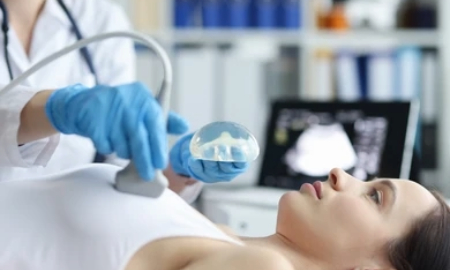
A breast ultrasound uses sound waves to examine breast tissue and the area of concern. It can help distinguish fluid-filled cysts from solid findings and assess visible changes. It complements clinical assessment and, when appropriate, mammography or tissue sampling. Current appointments start at £219, with the scope selected before booking.
A breast ultrasound uses sound waves to examine breast tissue and the area of concern. It can help distinguish fluid-filled cysts from solid findings and assess visible changes. It complements clinical assessment and, when appropriate, mammography or tissue sampling.
The practitioner focuses on the location you or your clinician identified. Describe the change and point out the exact area, even if it is not painful during the appointment.
Ultrasound can help characterise many visible findings, including whether they contain fluid. A solid finding is not automatically cancerous, and its significance depends on the complete assessment.
The service’s stated scope determines whether the armpit is included. Relevant accessible lymph nodes can be assessed, but ultrasound does not establish every cause of enlargement.
The appropriate scope may be one area or both breasts. Choose the booking that matches the concern and any referral; a larger scan is not automatically the most suitable test.
Before scanning, explain your symptoms, any relevant examination findings and the question raised by an earlier result. This helps the practitioner confirm that the requested examination matches your concern.
Tell the practitioner what has changed, any earlier findings and what your referring clinician wants to establish. If the concern needs a different investigation or a consultation, our team can explain the appropriate booking route.
Bring earlier mammograms, ultrasound reports and any referral or breast-clinic correspondence. Tell the clinician about previous biopsies, surgery, implants or breast cancer treatment.
Note when the lump or symptom started, whether it changes with your cycle, and any skin or nipple changes. Tell the team if you are pregnant or breastfeeding.
Wear clothing that is easy to remove from the upper body. The examination will be explained before consent; ask about a chaperone or any adjustment you need.
Preparation can change when tests are combined. Read the confirmation for the exact service you have booked and contact the team if the instructions are unclear, fasting is unsafe, or you need help with positioning, access or communication.
A focused examination for a concern affecting one breast or the relevant axilla. Confirm that this matches the requested investigation.
£219
Book targeted assessmentAssessment of both breasts and the axillae within the service scope. A breast consultation, mammography or biopsy may still be needed.
£259
Book bilateral assessmentYour practitioner reviews the concern and any relevant history, referral or previous report. Explain what you hope the examination will clarify so its scope can be confirmed.
The practitioner explains the technique, positioning and any particular limitations. You can ask questions before agreeing and raise discomfort or other concerns during the examination.
The technique is adapted to the body area and clinical request. The booking catalogue lists a 20-minute appointment slot for this service; the time spent scanning can vary.
The main observations are normally explained after a diagnostic scan. A written report commonly follows the same day or within 24 hours, depending on the service and any specialist review. Ask how the result will reach you or your clinician.
Ultrasound alone cannot rule out breast cancer and is not a substitute for the NHS breast screening programme. Mammography can show some changes that ultrasound does not demonstrate. If a finding needs a biopsy or a breast specialist’s assessment, arranging that step is important even if other parts of the scan appear normal.
If the result is reassuring but the original concern persists or changes, arrange appropriate clinical follow-up. If a finding needs further investigation, the next step may be a different test or a specialist assessment rather than repeating the same examination without a plan.
Check your selected service, fee and preparation before choosing a time. For alternative options listed above, use their individual booking links.
Secure online booking
Choose a time that suits you — we search every eligible specialist and confirm your appointment instantly.
Select any available day in the next 60 days.
Choosing a specialist re-draws the calendar to show only their available dates.
All fields are required unless marked optional.
Use the secure Stripe tabs below to select Card, Google Pay, Apple Pay or Klarna when available.
Payment methods shown depend on your device and the options enabled in Semble Pay. Card details are handled securely by Stripe and are not stored by this website.
Thank you, — a confirmation email has been sent to .
Your scan is booked. Anything selected below will be attached to the same booking and can be paid for at the clinic.
Practical information to help you choose the right next step.
General patient information. The most appropriate test depends on your symptoms, history and clinical assessment.
Confirm your chosen clinic and specialist when you book. Contact us in advance to discuss access, communication or chaperone requirements.
In the Harley Street medical district, convenient for central London and Bond Street.
View directions (opens in a new tab)Close to the city centre and St Albans City railway station.
View directions (opens in a new tab)Choose your service, review the booking options or speak to our patient team before deciding.
Every scan and health package, organised by clinical area.